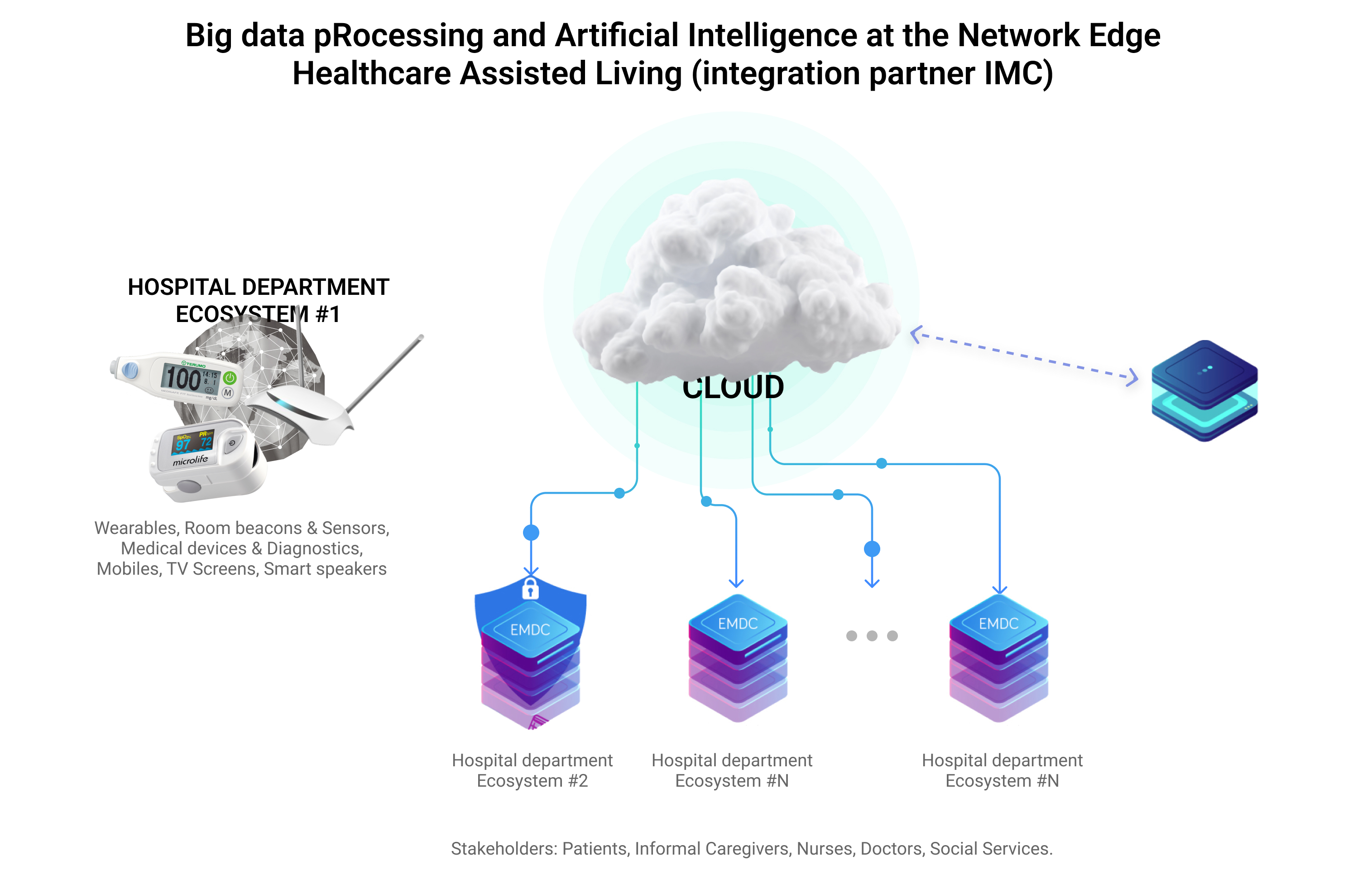
BRAINE is a European R&D project focused on Big Data processing and Artificial Intelligence at the network edge (Edge Computing). In the Healthcare Assisted Living use case, it addresses remote patient care, smart hospitals, and caregiving systems — not in the cloud, but as close to the patient as possible (at home, in hospital rooms, or in care facilities).The core idea is that data from medical devices are processed locally (on edge devices) — quickly, securely, and in full compliance with GDPR — rather than being continuously transmitted to centralized cloud infrastructures.
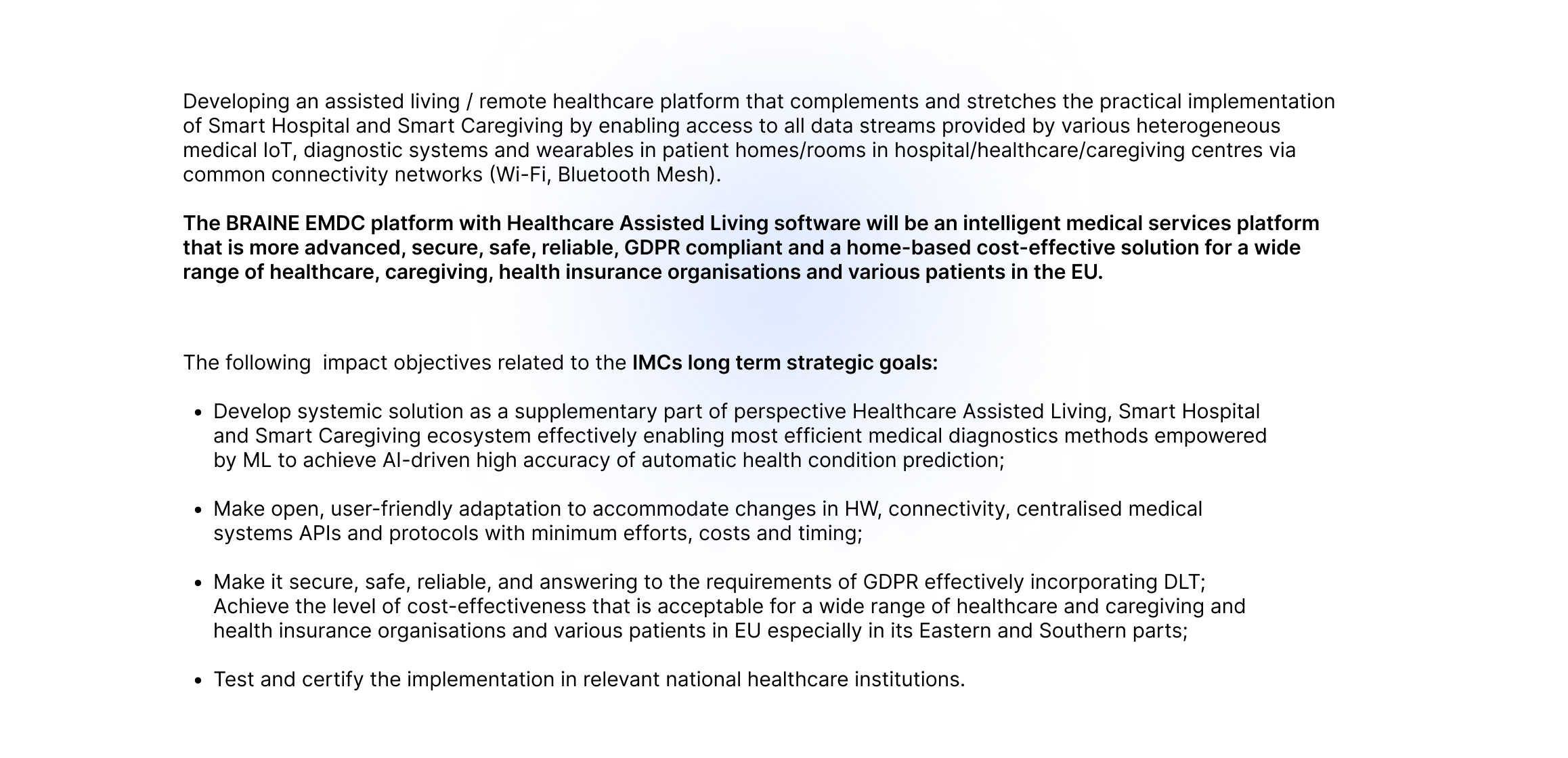
IMC is responsible for the integration of the assisted living and remote healthcare solution.

Healthcare data comes from heterogeneous devices (wearables, IoT sensors, diagnostic systems) using different formats and protocols, resulting in fragmented, non-interoperable data.
BRAINE Solution:
A unified edge platform that collects, harmonizes, and processes medical data in real time across Wi-Fi, Bluetooth Mesh, and other networks. Fewer errors and a unified real-time view of patient health.
Traditional healthcare systems are reactive, with limited automated prediction and a high workload for medical staff.
BRAINE Solution:
ML/AI models at the edge enable health deterioration prediction, anomaly detection, and early risk alerts through AI-driven medical diagnostics. Fewer emergencies and a shift toward preventive care.
Medical data is highly sensitive, cloud-based processing increases the risk of data breaches, and GDPR compliance is complex.
BRAINE Solution:
Local edge data processing with built-in security, privacy-by-design principles, and DLT-based access transparency, change control, and auditability. Patient data remains secure, trustworthy, and fully GDPR-compliant.
Existing healthcare systems are difficult to adapt — device changes require major reengineering, new APIs lead to costly integrations, and deployment cycles are long.
BRAINE Solution:
An open, modular architecture that enables easy integration of new hardware, protocols, and existing hospital IT systems. Faster scaling, lower integration costs, and future-proof deployments.
AI-Powered Remote Patient Care – intelligent monitoring and predictive health insights.
